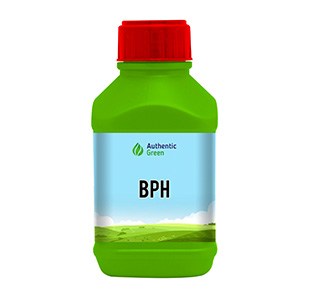
About BPH
A unique organic liquid formulation that brings down the damage of rice crop due to the infestation of Brown Plant Hoppers within 36 hours owing to its very specific way of multiple action. The unique feature of this product is that even after repeated sprays, there would be no resistance development in the pest population.
MODE OF ACTION
 Build resistance blockers in resistance building chain.
Attacks on nerve system of targeted pest.
Strongest anti feeding activity forces the pest to stops feeding on the host.
Epidermal ecdysiast have found of pest body.
Pest body loosing calcium++ from body in the form of water and muscle contraction have found. act on the nervous system.
It disrupts proper muscle function in insects and therefore represents a novel, unique mode of action.
Treated insects show unique symptoms of poisoning resulting in complete and irreversible contraction paralysis.
Muscle function was tested by electric stimulation of a motoneuron using an isolation stimulator (A350, World Precision Instruments) and observing the muscle contractions.
The insects loose muscle control, stop feeding, and exhibit a pronounced contraction paralysis of the whole body. Typically, the larvae become immobile or movements are very restricted and extremely slow.
When used in early life cycle of pest, it prevents the build up of pest population and maximize the yield.
Longer period of protection from the pest.
Sucking pest material is a fast acting botanical insecticide. Application ns of Sucking pest material as pro-phylactic spray i.e. in event of climate favoring pest incidence, or prior to an increase in pest numbers above Economic Threshold Level (ETL) leads to immediate feeding inhibition, reduction in fecundity and breeding ability of existing pests.
Build resistance blockers in resistance building chain.
Attacks on nerve system of targeted pest.
Strongest anti feeding activity forces the pest to stops feeding on the host.
Epidermal ecdysiast have found of pest body.
Pest body loosing calcium++ from body in the form of water and muscle contraction have found. act on the nervous system.
It disrupts proper muscle function in insects and therefore represents a novel, unique mode of action.
Treated insects show unique symptoms of poisoning resulting in complete and irreversible contraction paralysis.
Muscle function was tested by electric stimulation of a motoneuron using an isolation stimulator (A350, World Precision Instruments) and observing the muscle contractions.
The insects loose muscle control, stop feeding, and exhibit a pronounced contraction paralysis of the whole body. Typically, the larvae become immobile or movements are very restricted and extremely slow.
When used in early life cycle of pest, it prevents the build up of pest population and maximize the yield.
Longer period of protection from the pest.
Sucking pest material is a fast acting botanical insecticide. Application ns of Sucking pest material as pro-phylactic spray i.e. in event of climate favoring pest incidence, or prior to an increase in pest numbers above Economic Threshold Level (ETL) leads to immediate feeding inhibition, reduction in fecundity and breeding ability of existing pests.
FACTORS AFFECTING BPH OUTBREAK
10 DAYS AFTER PLANTATION OF THE CROP
Widespread planting of modern high yielding susceptible varieties
Increased use of nitrogen containing fertilizers
Increased use of insecticides
Rapid expansion of irrigation systems
Inadequate weed control
Prevalence of biotypes
Low relative humidity may be suitable for BPH population growth when there is adequate irrigation water. When the supplies of water is limited, a high relative humidity is favorable.
Very high rainfall seems to increase the mortality of the first and second instars nymphs.
On the other hand, it is believed that fairly high temperature and low rainfall condition are related to outbreak.
DAMAGE
The brown plant hopper damages the plant through the removal of the plant sap and as a vector of plant virusesviz., grassy stunt, ragged student and wilted stunt. The hoppers infest the plant at all stages of growth.
As a result of feeding by the nymphs and adults, plants turn yellow and dry up rapidly. At early infestation round yellow patches appear which turn brown due to drying up of plants. This condition is called hopper burn.
SEASONAL OCCURRENCE
The hoppers remain active throughout the year.
The population peaks in September and October and also during the later part of the cropping season. N. lugens occurs in overlapping generations.
LIFE HISTORY
The nymphs and the adults both brachypterous and macropterous are brown coloured. Adults mate on the day of emergence and the female start laying eggs from the day following mating.
Brachypterous females usually lay more eggs than macropterous forms.
The eggs are thrust into mid-region of leaf-sheath.
Eggs are covered with dome-shaped egg plug secreted by the female.
Eggs hatch in about 6-9 days.
The newly hatched nymph is cottony white and turns purple brown within an hour.
The nymphs take 16 to 18 days to reach adulthood.
MANAGEMENT
Avoid excessive use of nitrogen
Control irrigation by intermittent draining.
Drain the water before use of insecticides and direct the spray towards the base of the plants.
Apply Storm if BPH is present at the rate of 1 hopper/tiller in the absence of wolf spider and 2 hoppers per tiller when wolf spider at 1/hill.
DOSAGE
2 ml per 1 Litre of water or 250 ml per acre as a foliar spray
TIME OF APPLICATION
Start spraying as and when found a minimum of 25 to 30 BPH per hill and ensure a thorough spray directing the nozzle to the affected parts